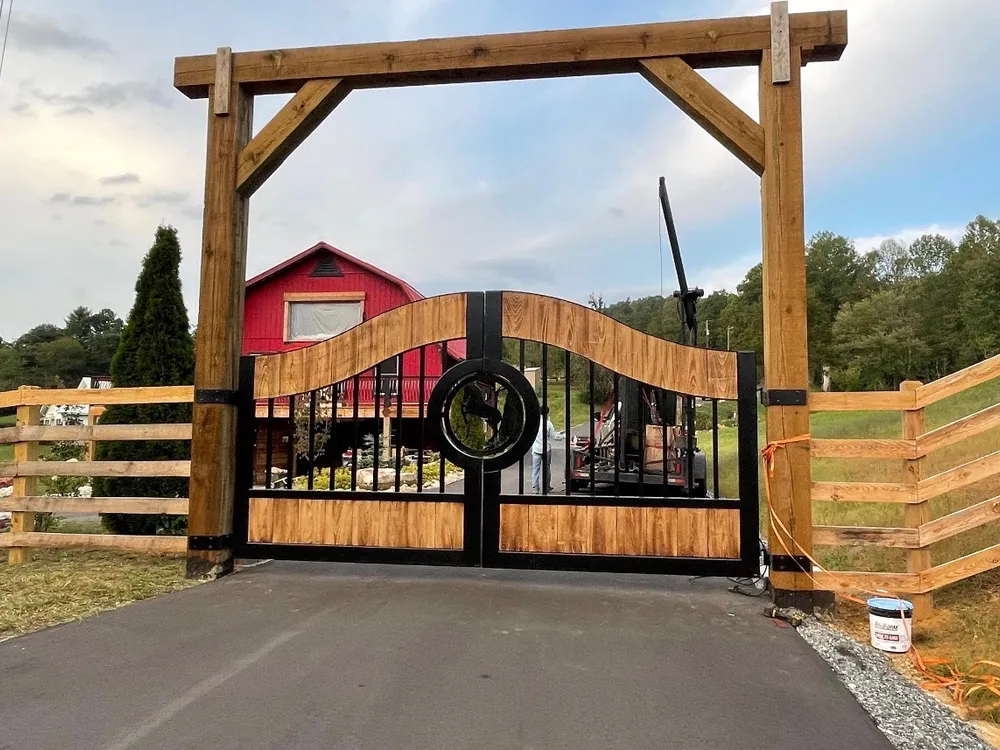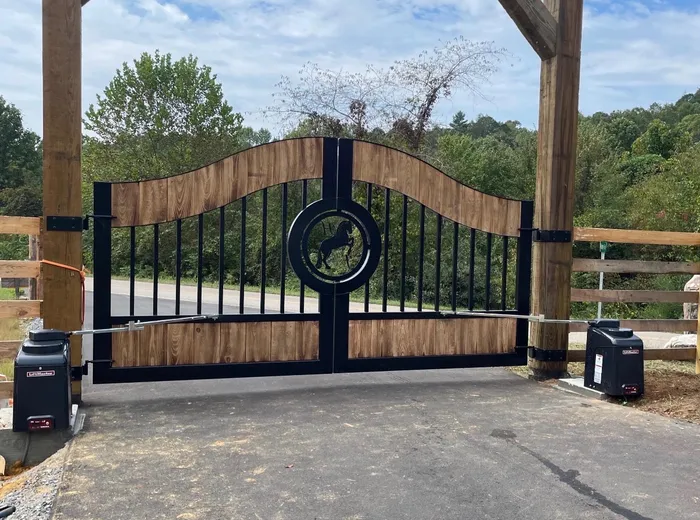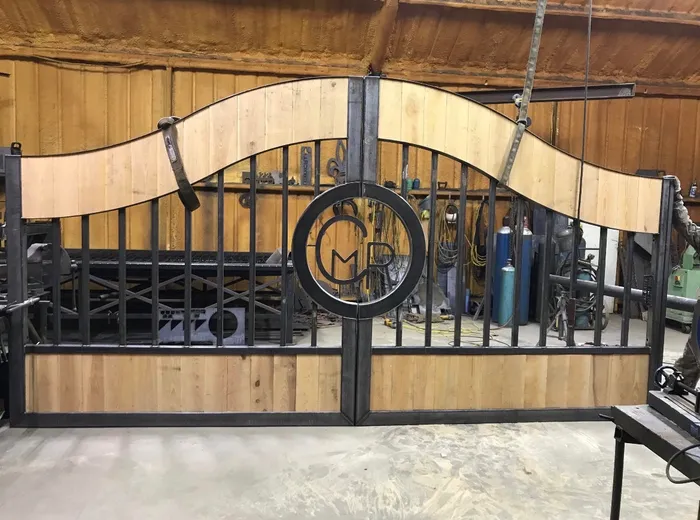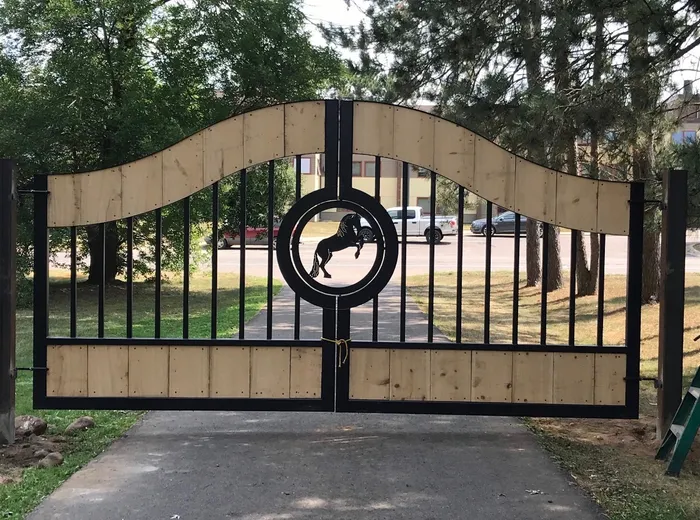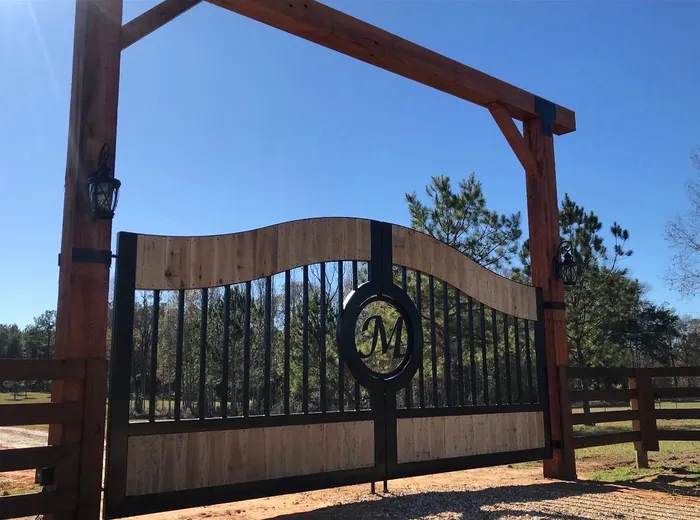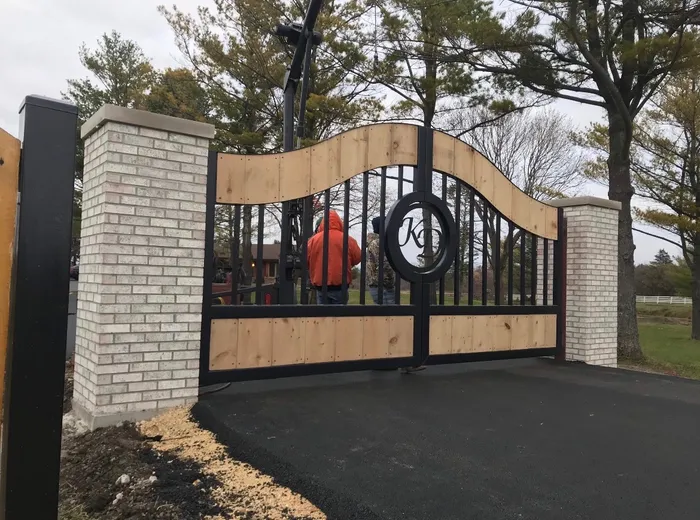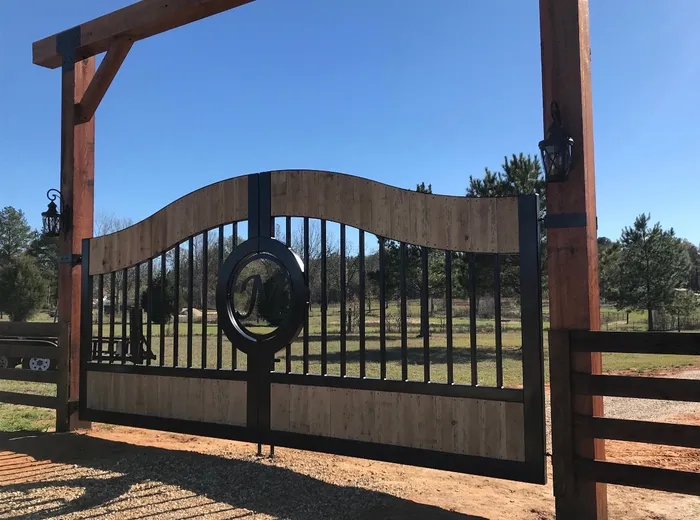
Wood boarding fills most of both leaves — an upper panel cut to the mirrored wave of the top rail, a matching panel along the bottom, and plain pickets across the open band between them. A ring straddling the centre joint is cut through with a monogram or a figure. The steel is black throughout, against boards left to show their grain.
The wave is a wooden edge rather than a steel one — the boards are cut to the curve and the frame runs as a thin black band along the outside of them, which is why the sweep reads soft where the rest of the gate is hard. Because the boarding takes both the top and the bottom of the leaf, the pickets show only in a band across the middle, which puts the one open stripe at about the height a driver actually looks through.
An entrance already framed in timber — a beam overhead, a post-and-rail line running off either side — is where this belongs; against that, an all-iron gate reads as a different building material arriving late. Where The Inman Gate gives its whole leaf over to worked steel, this one gives most of it to wood and keeps the ironwork to a frame, a band of pickets and the ring at the joint, which is the part that changes from build to build.
7 photos
Every angle