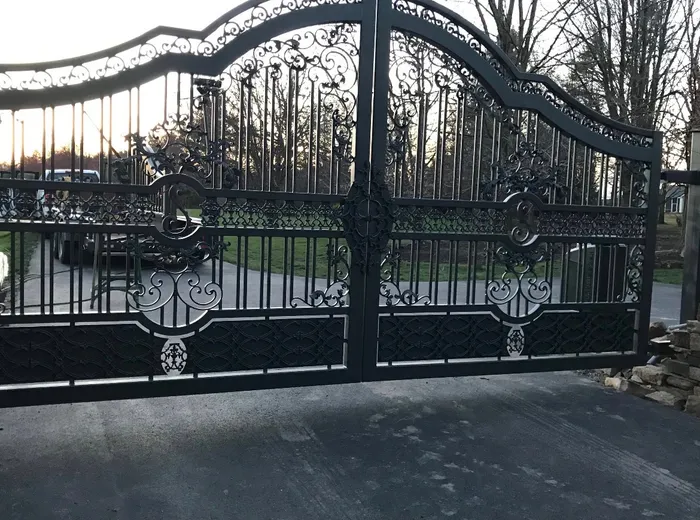
Filigree fills the crown — a tall arch peaking at the centre joint, its band packed with small scrolls, stepping down through a shoulder at each end. Close-set pickets run behind a mid-belt of repeating rosettes and a lower band of interlocking ovals, with a scrolled oval medallion centred on each leaf and a splayed scroll fan beneath it. Dark and near-black, hung between broad dry-stacked stone piers.
Look at the depth of it: pickets in one plane, a belt of repeating rosettes in front of them, and the scroll medallions standing off that again, so at an angle you are reading three layers of iron at once and each one shadows the layer behind. The pattern also changes three times between the ground and the crown — interlocking ovals low, rosettes at the belt, loose scrollwork in the arch — which is what keeps a gate this dense from going flat.
From the road all that depth collapses into two marks — the arch drawn against the sky, the banded base sitting solid across the drive — and only close in do the belts separate back into rosettes and ovals. Ornament this heavy usually costs a property its view; this one does not, because light carries through the pickets and through the openwork of both bands. Stone piers belong to the design rather than to the site: the arch has to rise clear of something with weight in it, and broad dry-stacked stone gives it that.
3 photos
Every angle