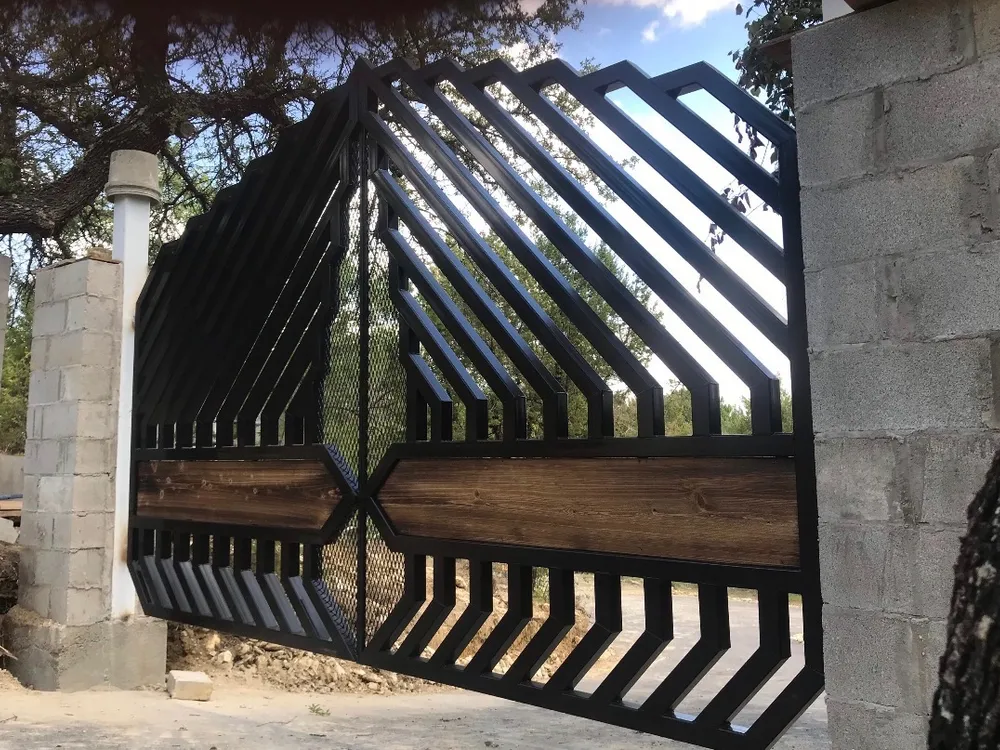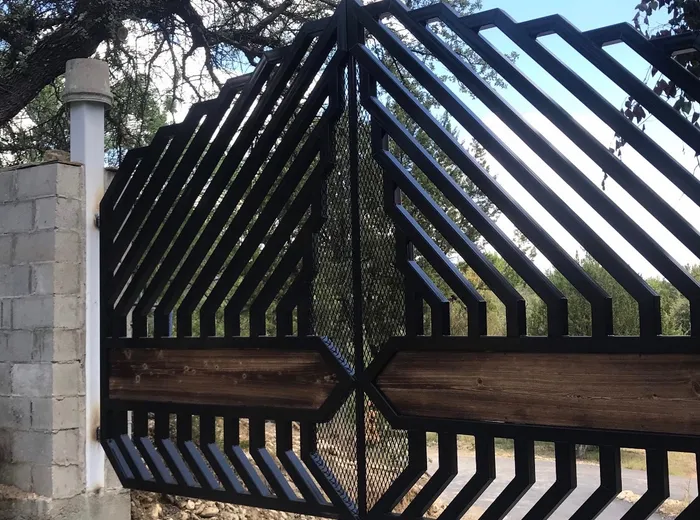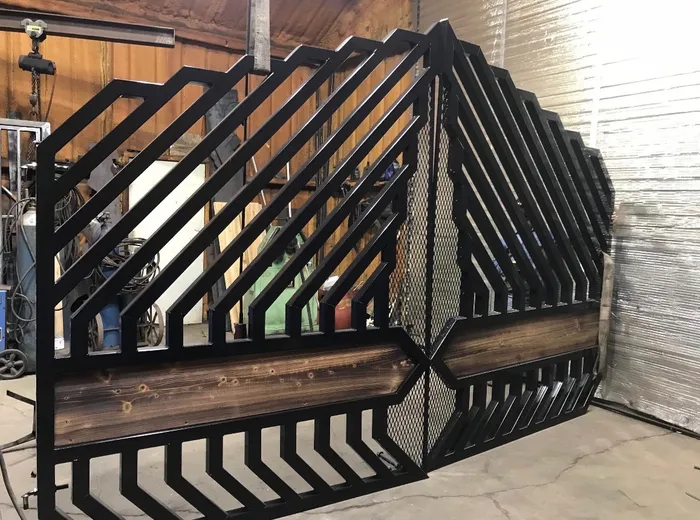
Every bar in this pair of leaves runs on the diagonal, mitred to a point down the centre so the face reads as one long chevron. The bars end at staggered lengths, and the step of those squared ends makes the gate's outline instead of a top rail. A band of dark-stained boards crosses the middle to an arrowhead at the joint, with diamond mesh behind the meeting stiles.
There is no top rail here at all. Each diagonal simply stops where the pattern says it should, and the staircase of squared ends left behind is the silhouette — an outline cut by the infill rather than framed by it, which is why the profile changes as you move past it. Above the timber the diagonals run straight and parallel; below it they are mitred into chevrons, and both fields reverse across the joint so the mitres meet the boards at a point.
This is the one for a house with flat planes and long horizontals, where scrollwork would look borrowed — it is about as far from The Inman Gate as the register goes. The Grand Lattice Gate crosses its diagonals into a dense repeating mesh; this design keeps them parallel and widely spaced, so the same forty-five degrees reads as line rather than texture.
3 photos
Every angle