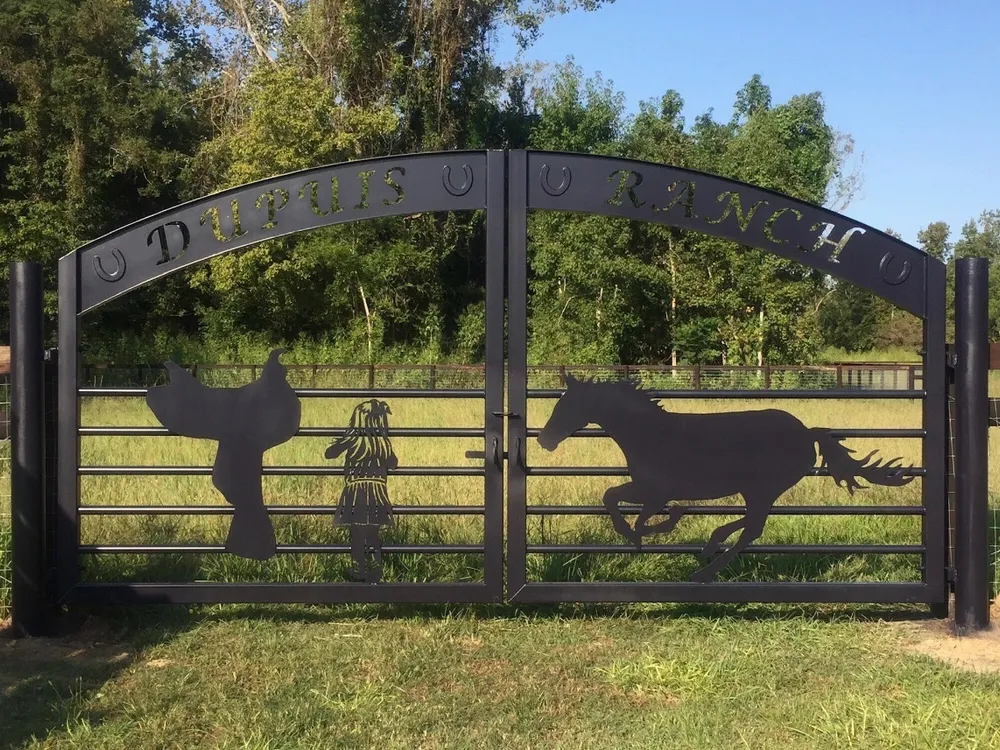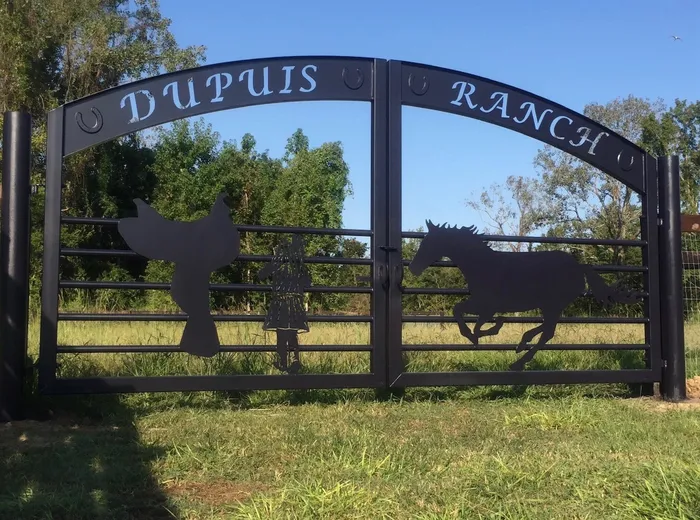
An arched band carries across both leaves with the property name cut through it in open letters, spaced out by small horseshoes. Beneath it, evenly spaced horizontal rails run the width of each leaf and carry cut silhouettes on their face — a western saddle with a small child standing beside it, and a horse at full gallop on the other leaf. All of it black, hung between square posts in a line of wire and wood fencing.
Two things do the work. The letters in the arch are voids, not applied plate, so they fill with whatever is behind the gate — green in summer, sky at the top of the curve — and the figures sit on the face of the rails while the rails run on behind them unbroken, so the frame stays a frame and the picture is simply added to it. The arch also gives the name somewhere to live without adding height to the leaves themselves.
The frame under all of it stays deliberately plain: a pasture entrance needs a name legible from the road more than it needs a scroll field, which is the opposite of what The Inman Gate is for. The saddle, the child and the horse are the part that changes from one build to the next; the arch, the name band and the rail spacing are what make it The Ranch Gate.
2 photos
Every angle