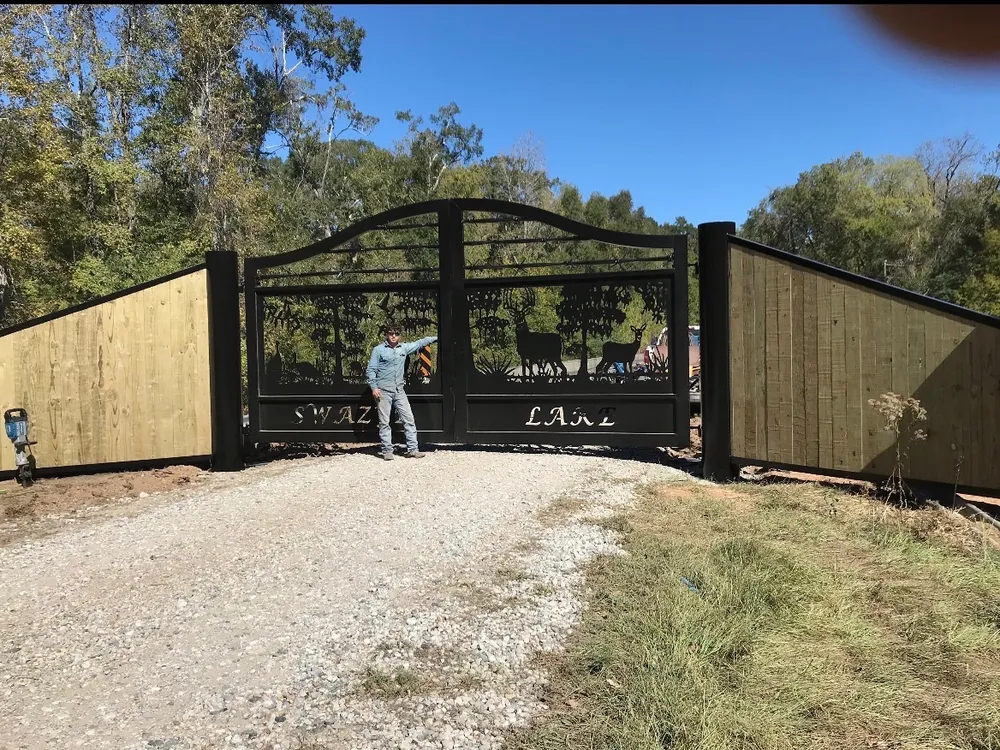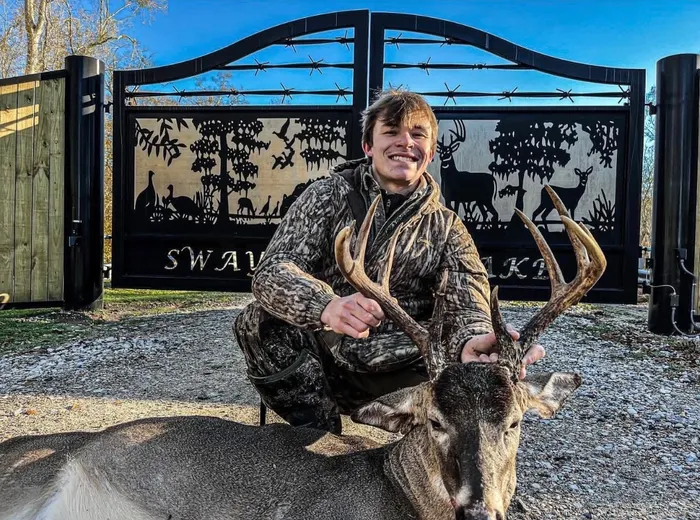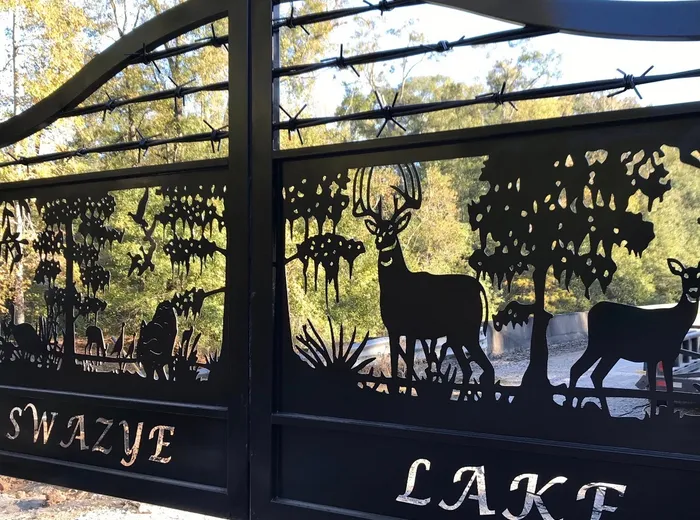
Cut silhouettes do the work here — a woodland scene taken straight out of the plate of both leaves, with a buck and does under hardwoods, ground birds and a hog low on the left, and small birds in flight above. Barbed-wire strands span the open top beneath an arched crown, and a solid band along the bottom carries cut lettering. Black throughout, hung on round posts between runs of black-capped wood privacy fence.
The scene is not ornament laid on the gate; it is cut out of the panel, so every tree and every animal is a hole in the steel and whatever stands behind the gate becomes the background of the picture. That is why the two leaves have to be drawn as one image — the tree line runs across the joint and the ground line has to arrive at the same height on both sides. The wire across the open top is steel as well, barbs and all, made up as part of the frame rather than strung between posts.
A cut scene suits a property with a subject to it: hunting land, a camp, a stretch of woods where the entrance is expected to say what is behind it. That makes it the opposite of something like The Grand Lattice Gate, which is pure geometry and will sit in front of any house — this one is drawn once, for one place, and does not transfer.
3 photos
Every angle